Introduction
(1) Leave a Nest’s training programmes are designed to empower diverse stakeholders (industry professionals, researchers, educators, and innovators) with the skills, knowledge, and mindset needed to thrive in an ever-evolving landscape.
(2) Focus on cultivating innovation, leadership, intrapreneurship, strategic collaboration, and problem-solving capabilities, tailored to meet the needs of a wide range of sectors.
Category
Innovation & Intrapreneurship Development
Main Purpose
– Designed for organisations and teams seeking to cultivate internal innovators (intrapreneurs) who can drive new initiatives and strategic growth.
Pain Point of the Issue
- – Teams lack initiative and rely on instructions instead of driving ideas.
- – Difficulty turning problems into actionable, innovative solutions.
- – Innovation efforts fail due to unclear direction and weak frameworks.
Research, Technology & Industry Bridging
Main Purpose
– Empowering researchers and technical professionals in industry and academia to align R&D with business, industry, and societal needs for real-world application.
Pain Point of the Issue
- – R&D outputs are misaligned with business, market, or industry needs, limiting real-world adoption.
- – Researchers and technical teams struggle to communicate value and applicability to non-technical stakeholders and partners.
- – Promising technologies remain siloed within R&D or pilot stages, failing to scale into impactful solutions.
Collaboration & Strategic Partnership Development
Main Purpose
– Fostering the capability to create, strengthen, and manage high-value collaborations across sectors.
Pain Point of the Issue
- – Difficulty forming meaningful, long-term partnerships.
- – Misaligned goals and expectations between collaborating parties.
- – Insufficient communication and structure to sustain collaboration.
Technology, Manufacturing & Monozukuri Excellence
Main Purpose
– Hands-on sessions rooted in Japanese monozukuri values — craftsmanship, precision, continuous improvement, and mission orientation.
Pain Point of the Issue
- – Inefficient processes and inconsistent product quality.
- – Lack of continuous improvement and disciplined work culture.
- – Unable to understand the whole concept of manufacturing.
Sector-Specific Innovation Programmes
Main Purpose
– Tailored for specialized industries looking to elevate their competitiveness and innovation capabilities.
Pain Point of the Issue
- – Struggle to keep up with evolving market and industry demands.
- – Limited capacity for innovation within specialized sectors.
- – Outdated practices and unclear pathways for new opportunity development.
Uniqueness
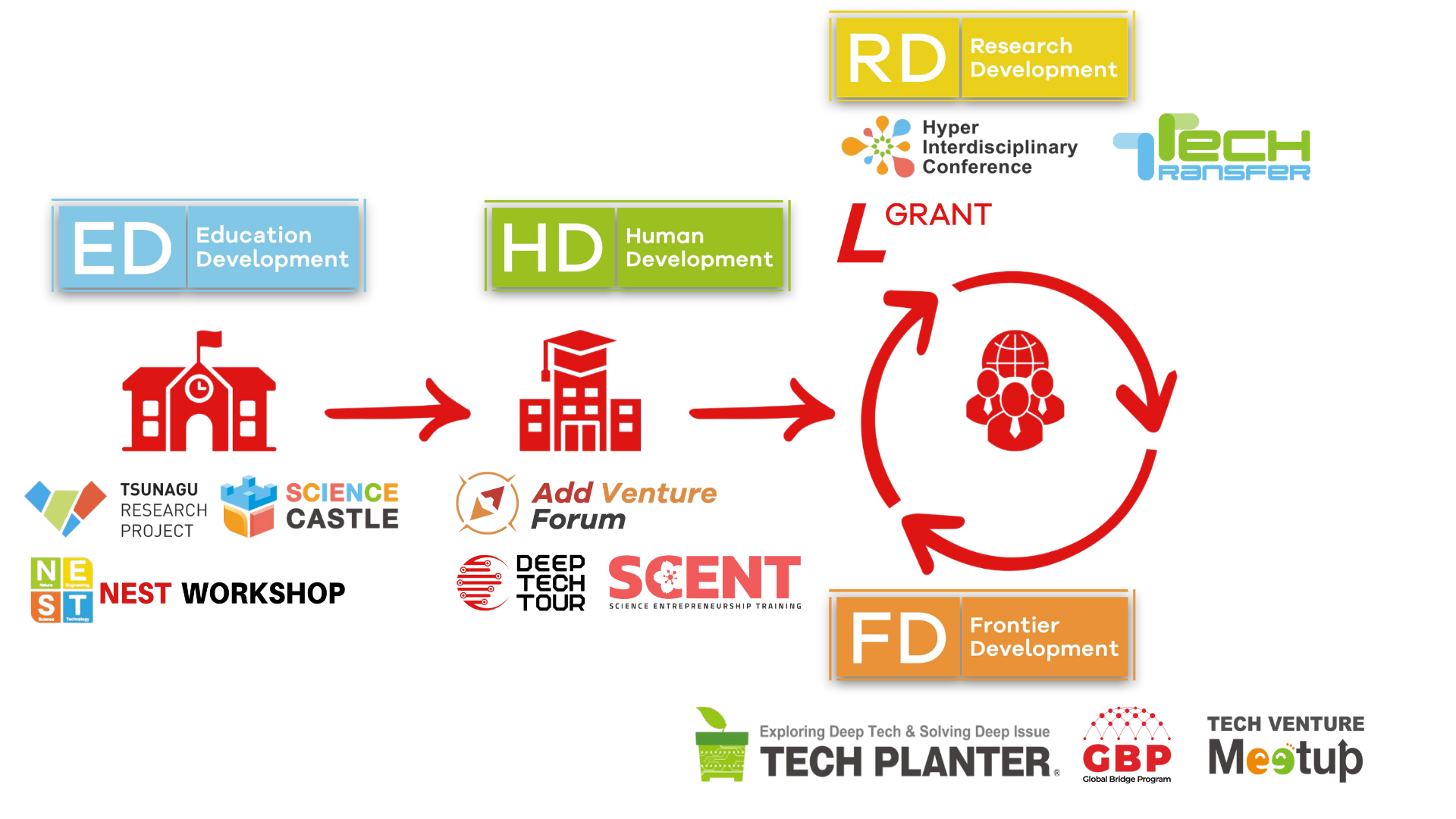
Continuity & Long-Term Impact
Cross-Sector Expertise
Global Knowledge × Local Insight
Integrated support system
Problem-driven approach
Trainer

Mr Abdul Hakim Sahidi
Graduated in Bachelor of Science: Electronic System, Universiti Teknologi Malaysia. As an HRDC-certified trainer, he brings a strong focus on growth and instills confidence in decision-making. His expertise lies in guiding organisations through periods of change and development. Articulate and driven, Abdul Hakim’s top strengths include relationship-building, strategic planning, and operational problem-solving, enabling him to deliver impactful learning experiences for diverse audiences

Mr Nur Ahmad Zaim Hussin
He graduated with a Bachelor of Electronic System Engineering from Universiti Teknologi Malaysia and has industry experience as an engineer in the telecommunications sector, where he supported drive test operations, data analysis, and network performance optimisation. He also brings strong expertise in management and essential corporate skills, strengthened by his leadership roles at Leave a Nest Malaysia, where he has been involved in strategic planning, project management, business expansion, and corporate training

Ir Dr Nor Ilia Anisa
She holds a PhD in Chemical Engineering and has worked extensively in industry and academia, giving her a unique perspective on bridging research, innovation, and real-world challenges. Her experience in engineering, education, and project development enables her to support participants in cultivating mission-driven thinking and applying knowledge for meaningful societal impact. She identifies gaps within the research ecosystem and facilitates sustainable collaborations between researchers and industry