
Post Panel News Release: Satellite Technology and the Future of Sustainable Agriculture
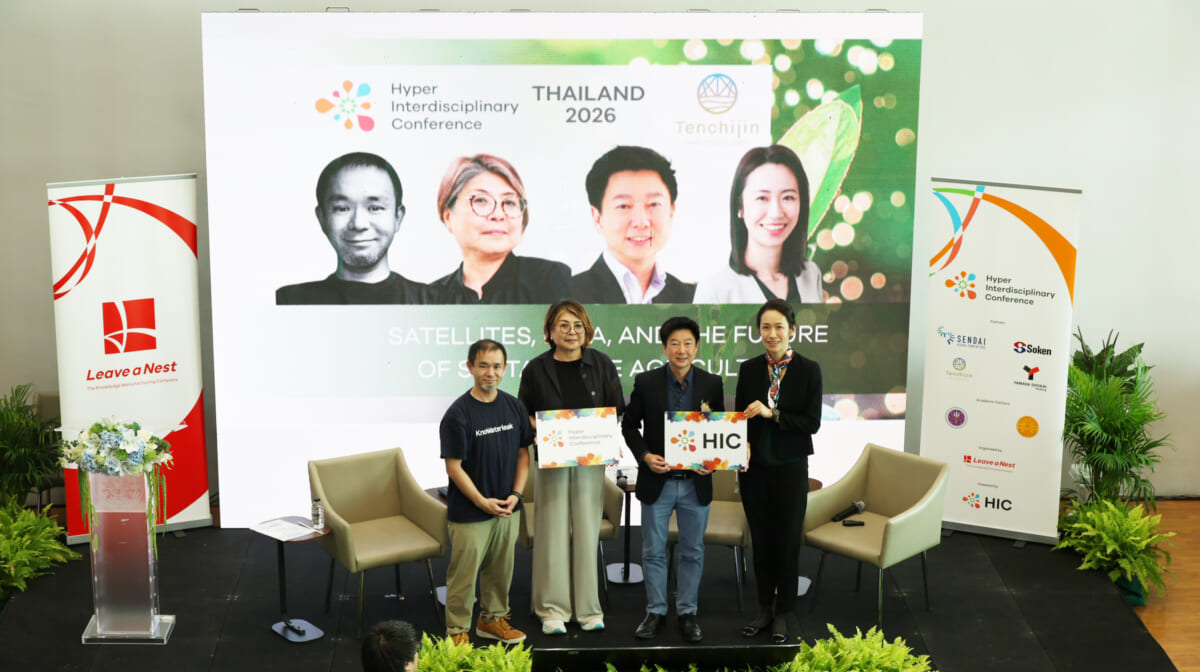
HIC Thailand 2026 brought together researchers, industry leaders, and innovators to explore how interdisciplinary collaboration can address some of today’s most pressing challenges. Across panel discussions and rapid-fire research sessions, a common theme emerged: meaningful innovation happens when technology, human needs, and diverse expertise come together.
From satellite-driven agriculture to healthy aging and early-stage research collaboration, the conference highlighted how integrated approaches can create scalable and impactful solutions.
One panel focused on how satellite data and advanced technologies are transforming agriculture. Featuring Dr. Takatsugu Kobayashi (Tenchijin Inc.), Ms. Junko Iwai (Storyline Co., Ltd.), and Assoc. Prof. Dr. Teerayut Horanont (Thammasat University), and moderated by Ms. Nami Akinaga (Leave a Nest Co., Ltd.), the discussion explored innovation across the agricultural value chain.
Assoc. Prof. Dr. Teerayut Horanont explained how drones and satellite imagery are being used to monitor crop health, particularly in banana plantations. These tools allow for early detection of disease and provide a comprehensive view of farming systems. The data can also distinguish cropping patterns, which supports government planning, especially in water management. He also highlighted a crop insurance application that combines satellite data with farmer-submitted images, significantly reducing the time needed to assess damage and process compensation.
Dr. Takatsugu Kobayashi emphasized the role of geospatial analytics in turning data into actionable insights. By integrating satellite imagery with ground and demographic data, his work identifies issues such as water leakage, land suitability, and energy potential. This approach helps decision-makers prioritize interventions and optimize resource use across sectors.
Ms. Junko Iwai brought attention to post-harvest innovation, introducing a supercritical CO2 process that removes caffeine from coffee while preserving its flavor. She emphasized the importance of relocating processing closer to producing regions such as Thailand, reducing inefficiencies while increasing local value creation. She also noted the potential of combining satellite technology with coffee farming to support smallholder farmers in improving both productivity and quality.
Together, the panel highlighted that integrating data, technology, and local knowledge can create more sustainable and efficient agricultural systems.