
Introducing Panel 3: The Language of Health — Connecting AI, Life Sciences and Human Well-being
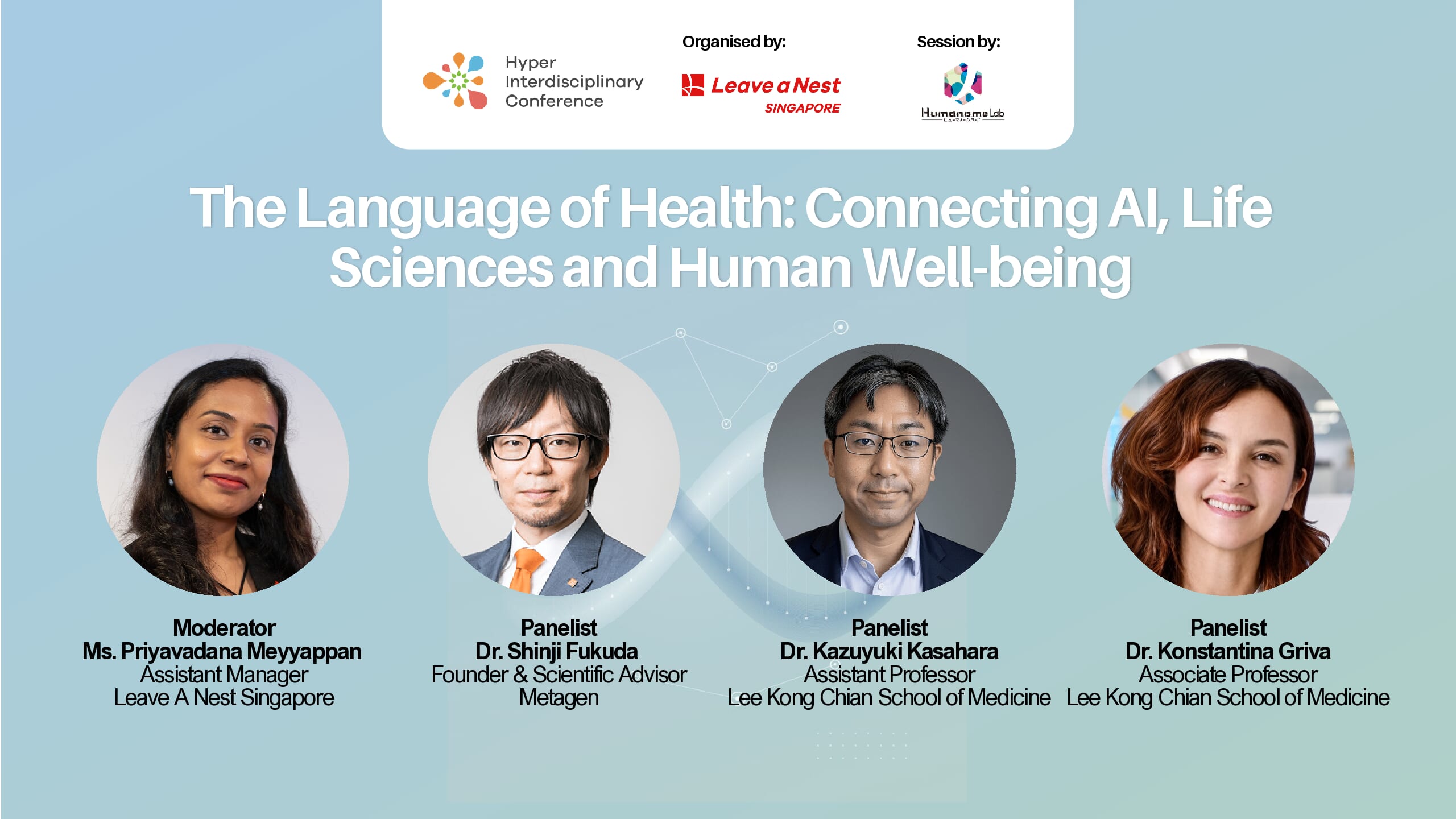
At the Hyper Interdisciplinary Conference (HIC) Singapore 2026 , Panel 3, “The Language of Health: Connecting AI, Life Sciences and Human Well-being,” will explore how biological research, data-driven insights and behavioral medicine can come together to translate scientific discoveries into meaningful improvements in human health.
Introducing Our Panelists
Asst. Prof. Kazuyuki Kasahara — NTU Lee Kong Chian School of Medicine, Singapore
Asst. Prof. Kasahara brings expertise in metabolic, nutritional and microbiome medicine, contributing insights into how the relationships between metabolism, the gut microbiome and biological systems can inform our understanding of human health.
Professor Shinji Fukuda — Metagen, Japan
Prof. Fukuda expertise in gut microbiome research and translational science. Through Metagen’s work in microbiome analysis, he explores how understanding the microbial communities within the human gut can support the development of personalized approaches to improving gut health and well-being.
Assoc. Prof. Konstadina Griva — NTU Lee Kong Chian School of Medicine, Singapore
Assoc. Prof. Griva brings expertise in health psychology and behavioral medicine, contributing perspectives on how health beliefs, patient experiences and behavioral factors influence engagement with healthcare innovations and the adoption of health-related interventions.
Moderator: Priya, Leave a Nest Singapore
When Scientific Discovery Meets Human Behavior
The gut microbiome provides an interesting example of the relationship between biological research and human behavior.
Stool sample analysis can generate valuable insights into the gut microbiome. However, the nature of sample collection and social perceptions surrounding stool testing may create discomfort or hesitation among individuals.
This raises an important question: How can behavioral medicine help bridge the gap between scientific innovation and public acceptance?
By connecting biological science, AI and behavioral medicine, the discussion aims to explore how healthcare innovation can move beyond generating scientific knowledge towards improving human well-being.
Join us at HIC Singapore 2026 and discover how connecting scientific understanding with human behavior can create new possibilities for personalized healthcare.
Event Details
- Date: Saturday, 21 November 2026
- Venue: NTU Lee Kong Chian School of Medicine, Novena Campus, Singapore
- Theme: Built with AI. Built for Impact.
- Program & Registration: https://hic.lne.st/schedule/sg2026/