
What Is the “Strategic Pathway” Required for Deep Tech Commercialization?
— Building Relationships That Enable the Next Proof of Concept, as Seen in Thailand–Japan Co-Creation
What is essential for the commercialization of deep tech is not the excellence of the technology itself. What is needed is a relationship that can move forward to the next proof of concept.
At first glance, this idea may feel counterintuitive. Isn’t it precisely because a technology is outstanding that it can be commercialized? Don’t large corporations choose to collaborate because a startup is attractive? Of course, that is not wrong. However, much of the stagnation observed in practice occurs not because of insufficient technology, but because of a disconnect before that technology is effectively linked to society and the market.
Thailand–Japan Co-Creation: Designing a “Strategic Pathway” to Commercialization
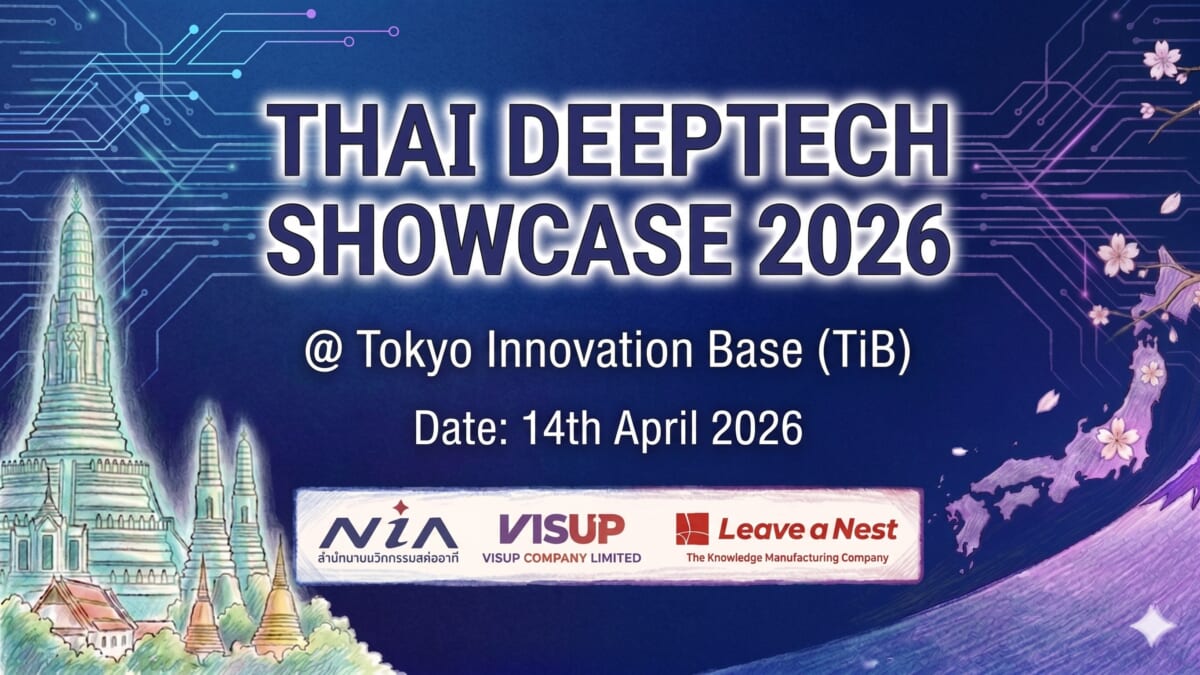
On April 14, 2026, at Tokyo Innovation Base, the panel discussion titled “Thailand–Japan Co-creation as a Strategic Pathway for Deep Tech Commercialization” at the THAI DEEPTECH SHOWCASE 2026 shed light on the true nature of this stagnation.
The panel brought together diverse stakeholders: Mr. Pariwat Wongsamran from Thailand’s National Innovation Agency (NIA), Dr. Pichaya Pattanasattayavong from Cleantech & Beyond, Mr. Akihiro Isumi from Soken Chemical, and moderator Dr. Kihoko Tokue from Leave a Nest. With representatives from government, startups, corporations, and ecosystem builders at the same table, the discussion moved beyond showcasing collaboration potential. Instead, it focused on how to design the mindset and structure necessary for deep tech commercialization.
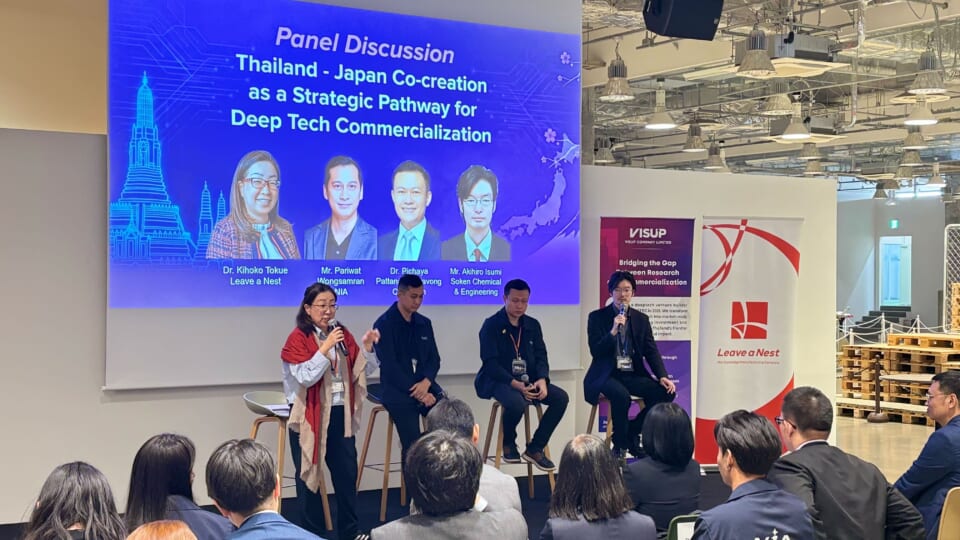
Tokue framed the session as an opportunity to explore what value Thai startups could offer Japanese companies. More than 40 participants—including corporations, financial institutions, municipalities, and research organizations—attended. The phrase “strategic pathway” in the panel title proved to be more than a slogan. The discussion revealed that commercialization is not a linear process; it only materializes when bridges are built between policy, challenges, markets, technology, and proof-of-concept stages.
From the Thai perspective, what stood out was that deep tech was not framed merely as a “promising emerging industry.” Instead, Mr. Pariwat described Thailand as a “gateway to ASEAN” and explained, in practical terms, why startups are encouraged to expand internationally. Deep tech is positioned within the context of national policy addressing complex societal challenges—food security, aging populations, climate change, energy, and industrial transformation. Here, deep tech is not simply advanced research—it is a means to solve real-world problems.
This perspective is equally important for Japanese companies evaluating overseas startups. The nine Thai startups that participated in the event tackled issues closely tied to both societal and market needs: food safety, plant-based materials, egg alternatives, natural coatings, solar panel performance enhancement, recycling of used panels, and materials derived from food waste.
What makes these startups compelling is not just their technological sophistication, but how clearly their technologies are connected to specific challenges and markets. As Pariwat noted, Japanese companies can utilize Thailand as a testbed, with a pathway to expand into Southeast Asia. In other words, technologies are not evaluated in isolation, but alongside their market trajectories.
Thus, a “strategic pathway” is not about identifying superior technologies alone. It is about understanding which challenges a technology addresses, and through which systems and stakeholders it can be brought to market. For Japanese companies considering international collaboration, what is truly needed is not a catalog of technologies, but the ability to read and design pathways to commercialization.
Why Meeting Startups Is Not Enough
Perhaps the most essential insight from the discussion was the identification of what actually blocks commercialization.
The conclusion was clear:
The bottleneck is not the lack of technology, but the lack of structures that enable different players to connect.
Governments possess policies and support mechanisms. Startups bring technology and agility. Corporations hold market access and customer relationships. Ecosystem builders create context across these actors. Yet even when each is strong individually, collaboration—such as joint development or proof-of-concept experiments—does not happen automatically.
This disconnect is particularly pronounced in deep tech. Unlike SaaS, where one can quickly test and adopt a solution, deep tech requires understanding the technology, forming hypotheses about applications, designing validation processes, and navigating regulatory and quality barriers. Even before business discussions begin, partners must determine what exactly should be tested together.
Therefore, the key is not simply to connect people, but to translate between parties who lack a shared language and transform them into collaborators.
Dr. Pichaya from Cleantech & Beyond candidly shared that entering the Japanese market felt like facing a “heavy first door.” Moving beyond basic communication required not just language ability, but interpreters who understand both business and cultural contexts. What matters is not the number of introductions, but the presence of a translation layer that allows meaningful dialogue.
This process of “translation” is labor-intensive. It involves translating startup technologies into corporate business challenges, and conversely, translating corporate requirements and market structures into actionable development themes for startups. It also requires aligning these efforts with institutional frameworks and support systems. Only then does the next step—proof of concept—become visible.
From the corporate side, Mr. Isumi emphasized that the most important factor in exploring opportunities abroad is clarity about one’s own challenges. Curiosity alone does not lead to business. Without a clear understanding of what problems need to be solved, it is impossible to determine which technologies to pursue. In other words, before searching for startups, companies must first define their own problems.
Ultimately, the panel highlighted that what deep tech commercialization requires is not just strong individual technologies, but a structure that enables translation and connection. The value of the event lay not merely in bringing nine startups to Tokyo, but in designing a flow—from panel discussions to pitches, exhibitions, and matchmaking—that creates a pathway from dialogue to validation.
Moving Beyond the Narrative of “Co-Creation”
This shifts the meaning of Thailand–Japan co-creation. International startup collaboration is often framed as “finding excellent technologies abroad.” However, the discussion revealed a deeper dynamic.
Thailand offers environments where technologies are developed in direct response to societal challenges. Japan offers strengths in materials, manufacturing, distribution, quality assurance, and customer bases. Rather than a one-way transfer of value, co-creation emerges when both sides bring complementary resources to build new use cases and market hypotheses.
As Dr. Pichaya noted, the Japanese market is not just a sales channel—it serves as proof of quality. Being accepted by Japanese companies signals credibility for expansion into other markets. At the same time, they understood from the outset that entering Japan would take time. As a result, they pursued a dual strategy: a long-term approach for Japan while timely optimizing products and solutions for the Thai market.
This reflects a broader shift in perspective: international expansion is not simply market entry, but multi-market business design.
In fields such as recycling and environmentally sustainable materials—where regulations and supply chain changes shape the market—it is not enough to buy finished solutions. The market itself is still being formed. Therefore, technology providers and application holders must collaborate early to shape both the validation process and the market itself. This is not about “finding partners,” but about co-developing business hypotheses.
An interesting example was the idea of “reverse pitching,” raised by Mr. Isumi—where large corporations present their challenges first, rather than startups presenting technologies. Pariwat responded that similar approaches are gaining traction in Thailand, noting that corporations have learned, through costly failures over five or six years of internal development, the necessity of collaborating externally.
This exchange illustrated that co-creation is no longer an idealistic concept, but a strategic response grounded in experience and cost.
How Do We Build Relationships That Enable the Next Proof of Concept?
At its core, the discussion leads to a simple question:
What should companies truly be looking for?
The answer is likely not “the best technology.” While technical excellence matters, it does not, by itself, trigger commercialization. What is needed is the ability to find partners—and build structures—with whom challenges can be shared, applications can be co-designed, and pathways to validation can be drawn.
In other words, the key is to create relationships that enable the next proof of concept.
Dr. Pichaya concluded by emphasizing that Thai startups possess not only strong technologies beyond food-related fields, but also a key strength: flexibility. This point is critical. Having strong technology and being able to move forward together are not the same. Both are required for successful co-creation.
The THAI DEEPTECH SHOWCASE 2026 itself served as a practical answer to this question. By bringing together government, startups, corporations, and ecosystem builders in one place to engage with shared issues, the event demonstrated what is necessary for deep tech commercialization. Equally important was the ability of participants—with different goals and expectations—to engage in meaningful discussions grounded in mutual respect and shared ownership.
Collaboration with overseas startups does not progress simply by increasing the number of meetings or introductions. What is required is clarity:
Which challenges to address, with whom, in what sequence, and through what validation process.
That clarity—the “map” of commercialization—was precisely what this panel made visible.
So, the final question becomes personal:
Are we truly searching for technology, or are we at a stage where we should be searching for structure?
If the latter is true, then perhaps what we should be evaluating next is not technical specifications, but with whom we can build relationships that lead to the next proof of concept.