
FFFS Future Energy Panel 1 Release: Next Generation Energy
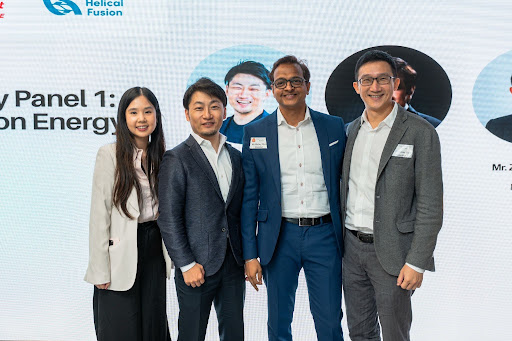
Next Generation Energy: Beyond New Technologies, What Will It Take to Power the Future?
As the world works towards a lower-carbon future, the energy industry faces an increasingly complex challenge. Electricity demand continues to grow, energy security has returned to the forefront of national priorities, and emerging technologies are opening new possibilities for how energy can be generated, transported and utilised.
Yet developing a promising energy technology is only part of the challenge. What does it take for that technology to become a commercially viable part of the energy system?
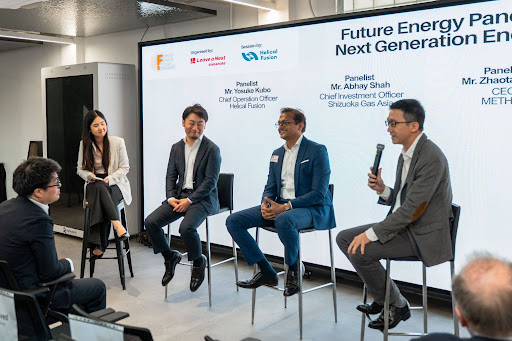
At the Future Food & Fuel Summit (FFFS) 2026 , organized by Leave a Nest Singapore with the support of the Embassy of Japan in Singapore, the panel Next Generation Energy brought together three perspectives spanning established energy infrastructure, renewable fuels and nuclear fusion.
The discussion featured Mr. Yosuke Kubo of Helical Fusion (Japan) , Mr. Abhay Shah of Shizuoka Gas Asia (Singapore) and Mr. Zhaotan Xiao of METHA8 (Singapore) , moderated by Fernanda Susilo of Leave a Nest Singapore.
Rather than examining these technologies in isolation, the conversation explored how the energy system is evolving, why some technologies scale faster than others, and the roles that Singapore, Japan and Southeast Asia can play in developing the next generation of energy.

A Changing Energy Landscape: Demand, Security and the Next Wave of Energy
Drawing on over 30 years of industry experience, Mr. Abhay Shah highlighted how rapidly growing electricity demand is placing pressure on energy infrastructure and equipment manufacturers. He also observed that geopolitical developments have pushed energy security higher on the agenda across parts of Asia. While decarbonization remains important, ensuring that electricity is available, affordable and reliable continues to be a fundamental priority.
Mr. Yosuke Kubo echoed these concerns, pointing to Singapore’s reliance on imported LNG and natural gas from Malaysia as an example of the vulnerabilities faced by countries with limited domestic energy resources. For Kubo, developing alternative sources of dependable electricity, including nuclear fusion, is an important part of strengthening long-term energy security.
Against this backdrop, Mr. Zhaotan Xiao introduced the idea that the energy transition is progressing through different technological waves. Following the expansion of solar, wind and batteries, he argued that renewable fuels represent an important wave of the transition today, offering solutions to challenges that renewable electricity generation alone cannot address.

From Green Electrons to Green Molecules: Southeast Asia’s Opportunity
Zhaotan illustrated the challenge using the example of solar electricity generated at exceptionally low costs in locations such as Saudi Arabia. While renewable electricity can be inexpensive to produce, transporting that energy to demand centres such as Singapore and Japan remains difficult. METHA8 sees methanol as a promising carrier for renewable energy, allowing electricity generated in resource-rich regions to be converted into a transportable liquid fuel.
This is especially relevant for Southeast Asia. Unlike Europe, where extensive natural gas pipeline networks support the distribution of gaseous fuels, Southeast Asia’s archipelagic geography presents different logistical requirements. Zhaotan argued that the region should capitalise on its biomass resources and develop liquid renewable fuels suited to its geography. He also shared that major regional energy companies, including Petronas and Pertamina, are exploring biomass-derived methanol production.
METHA8’s technology focuses on what happens once methanol reaches the point of use. The company is developing an electrochemical methanol-to-power system designed to extract more useful electricity than conventional combustion while keeping carbon dioxide in a concentrated stream for potential reuse. The opportunity, therefore, extends beyond developing an alternative fuel. It involves rethinking how renewable energy can be produced, transported, converted and potentially recirculated across the region.
Why Proven Energy Technologies Still Struggle to Scale
A key discussion point was that technological maturity does not necessarily translate into commercial adoption. Abhay drew a comparison between solar power and offshore wind. Although both technologies have existed for decades, solar has expanded rapidly across global markets, while offshore wind remains commercially established in fewer locations. He explained that scaling energy technologies depends on more than technical performance; regulation, infrastructure, market demand and financing all influence whether projects can move forward.
Using sustainable aviation fuel (SAF) mandates as an example, Abhay highlighted how government policies can create initial demand for lower-carbon alternatives that are not yet cost-competitive. However, large infrastructure projects also depend heavily on debt financing, with banks playing a significant role in determining whether projects reach a final investment decision.
Zhaotan expanded on this financing challenge, noting that even established renewable-fuel production technologies can struggle to secure early-stage project development funding, including pre-front-end engineering design (pre-FEED) financing. He also highlighted gaps in policy design, citing Indonesia’s biodiesel blending mandates. Although methanol is used in biodiesel production, the mandates do not necessarily require renewable methanol, allowing fossil-derived inputs to remain in the supply chain.
The exchange highlighted an important distinction: a technology can be technically ready without the commercial, regulatory and financing conditions needed for deployment.

Fusion: Building the Industry Before Commercial Power Arrives
While renewable fuels are being explored for nearer-term deployment, nuclear fusion represents a longer-term opportunity. Kubo acknowledged that fusion will not solve immediate energy supply challenges, discussing its potential contribution to commercial electricity generation around the 2040s and 2050s. However, he emphasised that fusion’s significance extends beyond when electricity can eventually be generated.
While fusion reactions have been demonstrated experimentally, translating these achievements into commercially viable power generation remains a significant engineering and industrial challenge, requiring advances in precision manufacturing, industrial scale-up and supply-chain development. For Helical Fusion, advancing towards commercial deployment therefore requires developing the industrial capabilities needed to manufacture and scale fusion systems, creating opportunities for countries to participate in the emerging industry well before commercial reactors become widespread.
Referring to remarks made by Singapore’s Minister Tan See Leng at FusionX, Kubo welcomed Singapore’s interest in developing fusion-related capabilities, particularly in talent development and industrial supply chains. He highlighted opportunities for Japanese fusion developers and Singapore’s industrial ecosystem to collaborate, even without immediate plans to install a fusion reactor in Singapore.
While commercial fusion electricity may still be decades away, the opportunity to participate in building the fusion industry already exists today.
Looking Ahead: Singapore, Japan and Southeast Asia’s Role
The discussion concluded by exploring how Singapore, Japan and Southeast Asia could contribute to these emerging energy pathways. Southeast Asia has considerable potential for renewable-fuel production, particularly through its biomass resources. Singapore and Japan, meanwhile, can contribute technological expertise, investment, industrial capabilities and regional connections.
Abhay emphasized that neither country necessarily needs to be the lowest-cost manufacturing location to play a meaningful role. Instead, their lie strengths in helping facilitate the partnerships, regulatory frameworks and commercial conditions needed to unlock regional energy projects. For renewable fuels, this could mean connecting Southeast Asia’s production potential with regional demand and investment. For fusion, it could mean developing specialized talent, manufacturing capabilities and supply chains ahead of commercial deployment.
The next generation of energy is unlikely to emerge through a simple sequence in which one technology replaces another. Established infrastructure, renewable fuels and future generation technologies will continue to evolve on different timelines, each addressing different needs.
For Singapore, Japan and Southeast Asia, the opportunity lies not only in developing new technologies, but also in bringing together the expertise, capital, infrastructure and partnerships needed to turn them into practical and commercially viable energy solutions.