
FFFS 2026 | Future Energy Panel 2: Unlocking the Full Potential of Renewable Energy
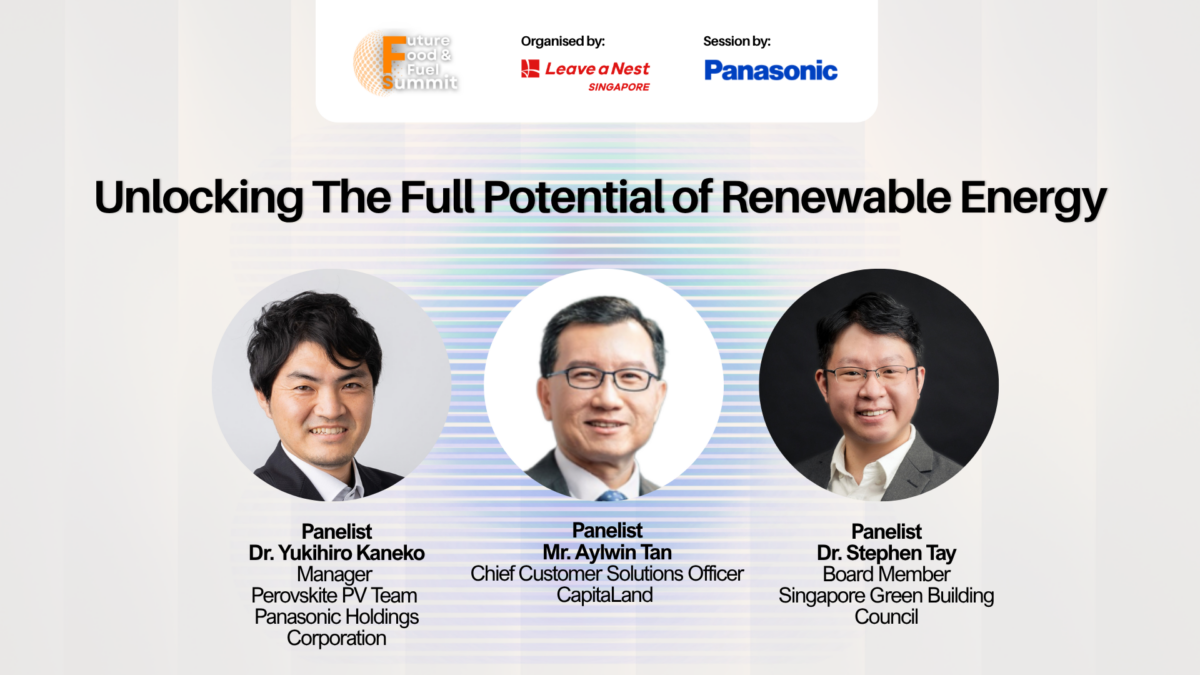
Why Unlocking Renewable Energy? From generation to integration in the cities we build
The renewable energy transition is not only about generating more clean power. For renewable technologies to create meaningful impact, they must also be effectively integrated into the buildings, infrastructure and cities where energy is consumed.
Against this backdrop, the Future Food & Fuel Summit (FFFS) 2026 will convene its second Future Energy panel, “Unlocking the Full Potential of Renewable Energy,” bringing together complementary perspectives across next-generation solar technology, sustainable urban environments, green-building adoption and real-estate development.
Panelists
Dr Yukihiro Kaneko
Head, Perovskite PV Business Promotion Office
Panasonic Holdings Corporation
Associate Professor Stephen Tay
Department of the Built Environment, National University of Singapore
Board Member
Singapore Green Building Council
Aylwin Tan
Chief Customer Solutions Officer
CapitaLand
Moderator: Leave a Nest Singapore
Taking place on Friday, 2 October 2026, from 2:00 PM to 3:00 PM , the panel will explore a central question: how can we unlock the full potential of renewable energy by moving beyond generation integration towards real-world deployment?
The discussion brings together three important parts of that journey. Panasonic brings the technology perspective through its work on glass-based perovskite photovoltaics and building-integrated applications. Associate Professor Stephen Tay brings research and green-building perspectives on integrating solar photovoltaics within sustainable urban environments, while CapitaLand brings the developer perspective on translating emerging solutions into buildings and real-world applications.
Together, the panel will explore how technologies such as next-generation solar and building-integrated photovoltaics (BIPV) could create new possibilities for renewable-energy generation within land-constrained cities, while examining the practical considerations that determine whether emerging solutions can progress from technological innovation towards widespread adoption.
The conversation will consider technology validation, building integration, standards, industry readiness, commercialization and collaboration between technology providers, researchers and deployment partners.
As Singapore and Japan commemorate 60 years of diplomatic relations, the panel will also explore how Japanese technology capabilities and Singapore’s built-environment ecosystem can come together to create pathways for validation, demonstration and deployment of next-generation renewable-energy solutions.
Meet the Panelists
Dr. Yukihiro Kaneko
Head, Perovskite PV Business Promotion Office, Panasonic Holdings Corporation
Dr Yukihiro Kaneko leads Panasonic’s Perovskite PV business, driving the commercialization of glass-based perovskite photovoltaic technology for building-integrated applications. His work focuses on integrating renewable energy into buildings and urban environments through innovative BIPV solutions. Working closely with developers, governments, researchers and industry partners, he advances pathways for technology validation, market adoption and sustainable urban development. He is particularly interested in how next-generation solar technologies can create value beyond power generation, enabling new possibilities for architecture, urban design and more resilient cities.
Associate Professor Stephen Tay
Department of the Built Environment, National University of Singapore | Board Member, Singapore Green Building Council
Associate Professor Stephen Tay obtained his PhD from Imperial College London under the National Research Foundation Clean Energy Overseas Scholarship. At the National University of Singapore, he received the Annual Teaching Excellence Award for three consecutive years, was placed on the University Honor Roll (2024–2028), and received the Outstanding Educator Award in 2026, NUS’s highest accolade for sustained teaching excellence and educational leadership. His research focuses on the integration of solar photovoltaics and greenery to support more sustainable urban environments.
Aylwin Tan
Chief Customer Solutions Officer, CapitaLand
Aylwin Tan leads CapitaLand Group’s customer solutions function, driving key account engagement and new initiatives that create value for customers and partners. Through his role, he brings a real-estate and developer perspective to discuss on how emerging technologies can be integrated into buildings and urban environments. His participation in FFFS provides an important deployment perspective, connecting technology innovation with the practical considerations, partnerships and opportunities required to translate new solutions into real-world applications.
Event Details
Future Energy Panel 2: Unlocking the Full Potential of Renewable Energy
Date: Friday, 2 October 2026
Time: 2:00 PM–3:00 PM
Venue: Padang & Co, Singapore
The Future Food & Fuel Summit 2026 is organized by Leave a Nest Singapore together with the Embassy of Japan in Singapore as part of SJ60, bringing together approximately 100 invitation-only stakeholders across industry, government, research, investment and deep technology.
Learn more about FFFS 2026:
https://hic.lne.st/en/schedule/future-food-fuel-summit-2026/